
TomasM
Worn Out 'F5' Key
- MBTI
- INFJ
The Somatic Marker Hypothesis
How Your Body Calculates Risk Before Your Mind Does
When faced with complex, high-stakes decisions, we are often told to "leave emotion out of it" and rely strictly on cold, calculated logic. However, the Somatic Marker Hypothesis—formulated by neuroscientist Antonio Damasio—reveals that pure logic is fundamentally flawed without the guidance of emotional feedback. Damasio proposed that during life experiences, the brain pairs specific scenarios with physical bodily responses, or "somatic markers"—such as a tightening stomach, a sudden spike in heart rate, or a subtle flash of tension. When we encounter similar choices under uncertainty, the brain rapidly reactivates these bodily states as anticipatory signals. Rather than clouding our judgment, these subconscious physical markers act as a cognitive shortcut, instantly tagging options as "dangerous" or "favorable" long before working memory can explicitly compute the odds.
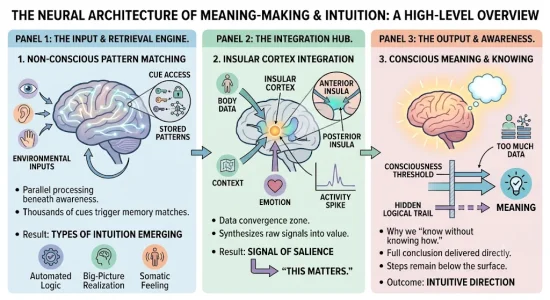
Crucially, somatic markers do not emerge from a single brain region, but represent the net output of a sophisticated neural circuit working beneath conscious awareness. Threat-detection systems in the amygdala, pattern-recognition networks in the basal ganglia, and memory-valuation hubs in the ventromedial prefrontal cortex all converge to trigger visceral feedback via the nervous system. The insular cortex then decodes these incoming bodily shifts, translating raw physical arousal into what we experience as a "gut feeling." High performers in high-stakes environments are not individuals who suppress these feelings; rather, they possess superior interoceptive sensitivity—the ability to register and integrate these bodily alarms. Those who struggle to process somatic markers often find themselves trapped in "analysis paralysis" or repeatedly falling for high-risk traps despite knowing the intellectual risks involved.
Ultimately, the Somatic Marker Hypothesis reframes intuition from an unpredictable hunch into an advanced evolutionary survival tool. In fast-moving, uncertain environments—such as financial markets, executive leadership, or emergency response—the sheer volume of variables makes pure rational calculation impossible. Somatic markers simplify the decision space by rapidly narrowing our options down to a manageable few, shielding us from short-term bias and catastrophic losses. By learning to tune in to this physiological dashboard, we gain access to an accumulated lifetime of experiential data, proving that our body’s intuitive signals are among the most rational decision-making assets we possess.
References
Damasio, A. R. (1998). The somatic marker hypothesis and the possible functions of the prefrontal cortex. The Prefrontal CortexExecutive and Cognitive Functions, 36–50. https://doi.org/10.1093/acprof:oso/9780198524410.003.0004
Dunn, B. D., Dalgleish, T., & Lawrence, A. D. (2006). The somatic marker hypothesis: A critical evaluation. Neuroscience & Biobehavioral Reviews, 30(2), 239–271. https://doi.org/10.1016/j.neubiorev.2005.07.001
Hinson, J. M., Jameson, T. L., & Whitney, P. (2002). Somatic markers, working memory, and decision making. Cognitive, Affective, & Behavioral Neuroscience, 2(4), 341–353. https://doi.org/10.3758/cabn.2.4.341
How Your Body Calculates Risk Before Your Mind Does
When faced with complex, high-stakes decisions, we are often told to "leave emotion out of it" and rely strictly on cold, calculated logic. However, the Somatic Marker Hypothesis—formulated by neuroscientist Antonio Damasio—reveals that pure logic is fundamentally flawed without the guidance of emotional feedback. Damasio proposed that during life experiences, the brain pairs specific scenarios with physical bodily responses, or "somatic markers"—such as a tightening stomach, a sudden spike in heart rate, or a subtle flash of tension. When we encounter similar choices under uncertainty, the brain rapidly reactivates these bodily states as anticipatory signals. Rather than clouding our judgment, these subconscious physical markers act as a cognitive shortcut, instantly tagging options as "dangerous" or "favorable" long before working memory can explicitly compute the odds.
Crucially, somatic markers do not emerge from a single brain region, but represent the net output of a sophisticated neural circuit working beneath conscious awareness. Threat-detection systems in the amygdala, pattern-recognition networks in the basal ganglia, and memory-valuation hubs in the ventromedial prefrontal cortex all converge to trigger visceral feedback via the nervous system. The insular cortex then decodes these incoming bodily shifts, translating raw physical arousal into what we experience as a "gut feeling." High performers in high-stakes environments are not individuals who suppress these feelings; rather, they possess superior interoceptive sensitivity—the ability to register and integrate these bodily alarms. Those who struggle to process somatic markers often find themselves trapped in "analysis paralysis" or repeatedly falling for high-risk traps despite knowing the intellectual risks involved.
Ultimately, the Somatic Marker Hypothesis reframes intuition from an unpredictable hunch into an advanced evolutionary survival tool. In fast-moving, uncertain environments—such as financial markets, executive leadership, or emergency response—the sheer volume of variables makes pure rational calculation impossible. Somatic markers simplify the decision space by rapidly narrowing our options down to a manageable few, shielding us from short-term bias and catastrophic losses. By learning to tune in to this physiological dashboard, we gain access to an accumulated lifetime of experiential data, proving that our body’s intuitive signals are among the most rational decision-making assets we possess.
References
Damasio, A. R. (1998). The somatic marker hypothesis and the possible functions of the prefrontal cortex. The Prefrontal CortexExecutive and Cognitive Functions, 36–50. https://doi.org/10.1093/acprof:oso/9780198524410.003.0004
Dunn, B. D., Dalgleish, T., & Lawrence, A. D. (2006). The somatic marker hypothesis: A critical evaluation. Neuroscience & Biobehavioral Reviews, 30(2), 239–271. https://doi.org/10.1016/j.neubiorev.2005.07.001
Hinson, J. M., Jameson, T. L., & Whitney, P. (2002). Somatic markers, working memory, and decision making. Cognitive, Affective, & Behavioral Neuroscience, 2(4), 341–353. https://doi.org/10.3758/cabn.2.4.341