Intuition - Origin and Definition

The Somatic Marker Hypothesis
How Your Body Calculates Risk Before Your Mind Does


When faced with complex, high-stakes decisions, we are often told to "leave emotion out of it" and rely strictly on cold, calculated logic. However, the Somatic Marker Hypothesis—formulated by neuroscientist Antonio Damasio—reveals that pure logic is fundamentally flawed without the guidance of emotional feedback. Damasio proposed that during life experiences, the brain pairs specific scenarios with physical bodily responses, or "somatic markers"—such as a tightening stomach, a sudden spike in heart rate, or a subtle flash of tension. When we encounter similar choices under uncertainty, the brain rapidly reactivates these bodily states as anticipatory signals. Rather than clouding our judgment, these subconscious physical markers act as a cognitive shortcut, instantly tagging options as "dangerous" or "favorable" long before working memory can explicitly compute the odds.

Crucially, somatic markers do not emerge from a single brain region, but represent the net output of a sophisticated neural circuit working beneath conscious awareness. Threat-detection systems in the amygdala, pattern-recognition networks in the basal ganglia, and memory-valuation hubs in the ventromedial prefrontal cortex all converge to trigger visceral feedback via the nervous system. The insular cortex then decodes these incoming bodily shifts, translating raw physical arousal into what we experience as a "gut feeling." High performers in high-stakes environments are not individuals who suppress these feelings; rather, they possess superior interoceptive sensitivity—the ability to register and integrate these bodily alarms. Those who struggle to process somatic markers often find themselves trapped in "analysis paralysis" or repeatedly falling for high-risk traps despite knowing the intellectual risks involved.

Ultimately, the Somatic Marker Hypothesis reframes intuition from an unpredictable hunch into an advanced evolutionary survival tool. In fast-moving, uncertain environments—such as financial markets, executive leadership, or emergency response—the sheer volume of variables makes pure rational calculation impossible. Somatic markers simplify the decision space by rapidly narrowing our options down to a manageable few, shielding us from short-term bias and catastrophic losses. By learning to tune in to this physiological dashboard, we gain access to an accumulated lifetime of experiential data, proving that our body’s intuitive signals are among the most rational decision-making assets we possess.

References

Damasio, A. R. (1998). The somatic marker hypothesis and the possible functions of the prefrontal cortex. The Prefrontal CortexExecutive and Cognitive Functions, 36–50. https://doi.org/10.1093/acprof:oso/9780198524410.003.0004

Dunn, B. D., Dalgleish, T., & Lawrence, A. D. (2006). The somatic marker hypothesis: A critical evaluation. Neuroscience & Biobehavioral Reviews, 30(2), 239–271. https://doi.org/10.1016/j.neubiorev.2005.07.001

Hinson, J. M., Jameson, T. L., & Whitney, P. (2002). Somatic markers, working memory, and decision making. Cognitive, Affective, & Behavioral Neuroscience, 2(4), 341–353. https://doi.org/10.3758/cabn.2.4.341
 
The Iowa Gambling Task
What a Famous Experiment Teaches Us About the Science of Intuition


I did this test when 30 years old.
Reading my reports I see that they say I do not have ADHD but decisions are impaired.
I get very depressed sometimes and my motivation levels are low.
I have to make life decisions under constant stress.

That could be like what they call burnout.

My intelligence is not low, it takes energy to weight all the factors involved which can be emotionally painful.

Intuition under pressure is a reason people can make poor decisions. Yet supertaskers exist that get things done more.

2017
IGT2
Trial Administered 100
Total Money $-2,395
Liberal style, speed over accuracy(T-Score < 40 = 38)

FSIQ 109
GAI 124

2025
D-KEFS Tower Test (Z score -0.67)
WCST (Z score -3.18 learning to learn)
Factor: Visual Learning Memory Standard Score 110 (75th percentile)
 
Faster Than Thought
The Hidden Neuroscience of Intuition

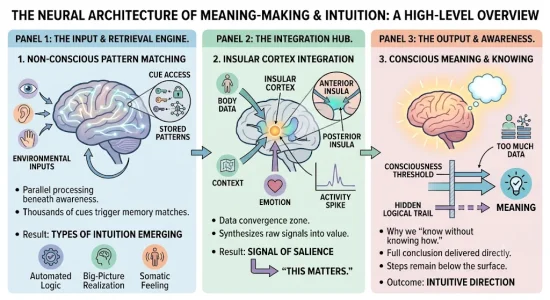
When you experience a sudden flash of insight, a subtle "gut feeling," or a big-picture realization, your brain hasn't bypassed logic—it has simply outsourced it to the background. Beneath conscious awareness, the mind acts as a high-speed search engine using a process known as cue access. Environmental inputs serve as retrieval probes, triggering parallel pattern-matching across millions of stored memory traces in milliseconds. Because this processing happens beneath working memory, intuition takes several distinct forms—a framework captured by the Types of Intuition Scale (TIntS). Depending on the cues retrieved, your brain might surface an inferential intuition (automated expert logic), a holistic intuition (suddenly seeing how disparate pieces fit together), or an affective intuition (an emotional or visceral signal).

The brain must then transform these subterranean data matches into something you can actually consciously experience. This is where the insular cortex plays a pivotal role, serving not as the "seat" of intuition, but as an integrative hub for meaning-making. Data from across the brain—including sensory feedback, cognitive context, and bodily signals (processed in the posterior insula)—converge in the anterior insula. Neuroimaging consistently shows activity spikes in this region when the brain is attempting to resolve ambiguity or assign value to a situation. By synthesizing raw bodily shifts with higher-order cognitive networks, the insula translates subconscious pattern recognition into a conscious signal of salience: a clear internal prompt that says, "This matters."

1785698214384.webp

This neural architecture explains the central paradox of intuition: knowing something without knowing how you know it. Intuition thrives at the extremes of information—when there is either too little data for step-by-step logic, or too much data for working memory to hold at once. In these moments, the brain’s parallel processors skip the slow, serial effort of verbal reasoning and deliver only the final output to consciousness. Meaning arrives fully formed, but because the cue-matching and insular synthesis occurred below the surface, the logical paper trail is hidden. You are left with a precise sense of direction, powered by a sophisticated neural network working faster than thought.

Note: This thread post is not to suggest how the mind or brain is functioning completely or where consciousness is occurring but instead is focused on some key areas of the brain which are functioning somewhat collectively towards an intuitive awareness. By doing this there is an opportunity to refine it with consciousness based models.

References & Foundations

Craig, A. D. (2009).
How do you feel—now? The anterior insula and human awareness. Nature Reviews Neuroscience, 10(1), 59–70.
DOI: https://doi.org/10.1038/nrn2555
  • Role in post: Outlines how bodily feedback moves from the posterior insula to the anterior insula, transforming raw interoceptive signals into subjective awareness and emotional feelings.
Damasio, A. R. (1994). Descartes' Error: Emotion, Reason, and the Human Brain. Grosset/Putnam.
Link: Penguin Random House Entry
  • Role in post: Formulates the Somatic Marker Hypothesis, demonstrating how non-conscious emotional and bodily evaluation tags guide rapid decision-making before conscious logic takes over.
McElree, B. (2006). Accessing information in working memory. Psychology of Learning and Motivation, 46, 155–200.
DOI: https://doi.org/10.1016/S0079-7421(06)46005-9
  • Role in post: Establishes the direct-access (content-addressable) retrieval model, showing that memory traces matching a probe are evaluated in parallel beneath working memory limits.
Menon, V., & Uddin, L. Q. (2010). Saliency, switching, attention and control: A network model of insula function. Brain Structure and Function, 214(5-6), 655–667.
DOI: https://doi.org/10.1007/s00429-010-0262-0
  • Role in post: Frames the anterior insula as the key hub of the brain’s Salience Network, marking subconscious matches as important and shifting them into conscious focus.
Pretz, J. E., & Totz, K. S. (2007). Measuring individual differences in affective, heuristic, and holistic intuition. Personality and Individual Differences, 43(5), 1247–1257.
DOI: https://doi.org/10.1016/j.paid.2007.03.015
  • Role in post: Provides the empirical basis for the Types of Intuition Scale (TIntS), categorizing intuition into affective, inferential (automated logic), and holistic forms.


I wasn't able to find the study that discussed a greater development of the corpus callosum in ambidextrous individuals, but I believe the suggested links could be a respectful addition to the work you are carrying out.

A great book that helped me understand this concept (which I experience firsthand) is :Drawing on the Right Side of the Brain — Betty Edwards

Congratulations on the work you've been doing!

-G
 
Extraverted Intuition = Greater Associative Horizon

It is divergent thinking ideas connect to each other at rapid speed.

ADHD, Ideas, Creativity, and the Default Mode Network​


Introverted Intuition be more convergent where we find that the idea is relevant to our actual immediate environment.

Starship Troopers Card Scene​

 
The Silent Partner
What Split-Brain Science Reveals About Intuition

Imagine opening your closet in the morning, reaching for a jacket with your right hand, and having your left hand reach out to grab a completely different coat.

This isn't a hypothetical thought experiment. It is a documented phenomenon in split-brain patients whose corpus callosum—the nerve bundle bridging the brain’s two hemispheres—was severed to treat severe epilepsy. When that bridge is cut, we don't observe half a mind. We reveal two distinct, co-existing processing styles sharing the same head, occasionally acting in direct opposition.


The "Interpreter" vs. The Silent Observer​

The most striking takeaway from split-brain research isn't just that the hemispheres can disagree, but how they handle information.

Because primary speech centers reside in the left hemisphere, only that side can articulate what it experiences. When researchers present a visual cue exclusively to the non-speaking right hemisphere, the patient acts on it physically. Yet when asked why they performed the action, the speaking left brain doesn't admit it is out of the loop. Instead, it instantly fabricates a plausible, logical story to rationalize the behavior after the fact.

Meanwhile, the non-verbal right hemisphere excels at holding broad context, recognizing patterns, and registering implicit environment signals—all without saying a word.

What This Means for Intuition​

We often treat intuition as an inexplicable "feeling or instinctive action." But viewing it through the lens of hemispheric interaction grounds the concept: Intuition is often the non-verbal processing engine at work long before explicit logic catches up.

While the analytical side demands structured narratives and verbal proof, the non-verbal mind constantly evaluates complex relational cues and patterns. When you get a sudden, inexplicable sense about a situation, you aren't lacking logic. You are experiencing a non-symbolic form of intelligence that reached a conclusion seconds before your internal storyteller constructed a rationale for it.

A Note on Plasticity: Does intuition require both halves? Remarkably, patients who undergo a hemispherectomy (the removal of an entire brain hemisphere) demonstrate that a single remaining side can rewire its internal networks to support both implicit, non-verbal pattern recognition and explicit narrative processing.

References:


Evans, J. S. B., & Stanovich, K. E. (2013). Dual-process theories of higher cognition: Advancing the debate. Perspectives on Psychological Science, 8(3), 223–241. https://doi.org/10.1177/1745691612460685

Gazzaniga, M. S. (2000). Cerebral specialization and interhemispheric communication: Does the corpus callosum enable the human condition? Brain, 123(7), 1293–1326. https://doi.org/10.1093/brain/123.7.1293

Kliemann, D., Adolphs, R., Tyszka, J. M., Alsford, T., Candia, V., & Paul, L. K. (2019). Intrinsic functional connectivity of the brain in adults with a single cerebral hemisphere. Cell Reports, 29(8), 2398–2407. https://doi.org/10.1016/j.celrep.2019.10.067

McGilchrist, I. (2010). Reciprocal organization of the cerebral hemispheres. Dialogues in Clinical Neuroscience, 12(4), 503–515. https://doi.org/10.31887/DCNS.2010.12.4/imcgilchrist
 
Finding Frequency
'The Hill,' Consciousness, and the Spaces We Seek Online

I’ve spent a lot of time lately looking at how our understanding of intuition changes when we reframe how the mind actually works. We’re often taught that the brain generates consciousness. But what if the brain is simply a receiver, tuning into a much broader signal?

When we entertain the idea that the mind and brain are separate, phenomena like Near-Death Experiences (NDEs), Out-of-Body Experiences (OBEs), and telepathy stop looking like random anomalies. They become indicators. They suggest that our awareness isn't locked inside our skulls, but extends outward into a shared, collective field.

In this light, intuition isn’t just an isolated "gut feeling." It is our nervous system transducing information from that broader field into physical knowing.

This brings me to a concept explored in The Telepathy Tapes: "The Hill."

Non-speaking spellers describe "The Hill" as a shared, non-physical landscape where they meet and communicate beyond verbal language. Whether we look at this literally or as a metaphor for non-local mind, it presents a compelling picture of collective consciousness—a space defined not by geography, but by pure resonance.

What fascinates me is how closely this parallels what is happening in our physical world every day.

Many people with elevated intuition, high sensory processing sensitivity, or lower-spectrum autism find physical environments overwhelming. Navigating eye contact, social masking, and environmental noise forces a sensitive system to dial down its intuitive antenna just to cope.

So, where do these systems go? They gather online.

In quiet Discord channels, specialized forums, and niche digital communities, people with sensitive perception gather to share patterns and hyper-fixations. Free from physical sensory friction, these digital spaces function as a modern, technological version of "The Hill." Communication becomes conceptual, asynchronous, and remarkably aligned. In these pockets, it’s common to see simultaneous realizations—different people arriving at the exact same intuitive breakthrough at the same time.

I don't offer this to draw hard conclusions or declare a single truth. Rather, I see a pattern worth reflecting on. Whether experienced through non-local consciousness, the accounts of spellers on "The Hill," or the quiet text channels of an online group, a unified theme emerges: when physical barriers drop, sensitive human minds naturally seek resonance.

If you’ve ever felt more understood by avatar names in a late-night forum than by a room full of people, you might not just be "browsing the web." You might be participating in a digital expression of an ancient mechanism—finding your frequency on the hill.

Some media explaining The Hill.


I’ve spent a lot of time lately looking at how our understanding of intuition changes when we reframe how the mind actually works. We’re often taught that the brain generates consciousness. But what if the brain is simply a receiver, tuning into a much broader signal?

When we entertain the idea that the mind and brain are separate, phenomena like Near-Death Experiences (NDEs), Out-of-Body Experiences (OBEs), and telepathy stop looking like random anomalies. They become indicators. They suggest that our awareness isn't locked inside our skulls, but extends outward into a shared, collective field.

In this light, intuition isn’t just an isolated "gut feeling." It is our nervous system transducing information from that broader field into physical knowing.

Each individual neuron in the brain might operate as an antennae but together they work to create a map of reality.

The brain creates its own personal simulation of what it receives from the outside world and it might not be perfect so introduces bias.

Like I cannot see my thoughts, they are all nonsymbolic thought.

Definition:

Nonsymbolic thought (often called unsymbolized thinking) is a clear, specific, and conscious thought that occurs entirely without the use of words, mental images, or any other sensory symbols. It is a direct grasp of meaning in the mind, standing as one of the fundamental types of human inner experience.

I do not often have extrasensory awareness of things outside myself, I am not psychic, I do operate on emotions.

I understand that I am different, have different experiences than others, it is based on how people view the world that we come to our understandings of it. So I can understand its possible peoples inner maps are translating reality into another way of looking at things.

Temple Grandin the autistic lady said dogs can see images in their heads when they smell things, smellovision.

So maybe psychic things are possible but the phenomena would be in perceptions and science mostly knows how neurons do so with memory. It is just that they have not categorized all modes of perception but they are sure it has a physical bases of mechanism. The white matter and grey matter underly how signals are propagated in the brain network for metabolic homeostasis and mapping the environment for navigational purposes.
 
Last edited:
The ability to know something might just be a vibration going into the unconscious.

Birds can navigate via magnetism in their retinas being sensitive to it.

Animals know when earthquakes come before it happens.

Sound is powerful and affects the body.

So maybe if we can sense sounds not on a conscious level but unconscious level this might explain some phenomena.

The sound would go into the bones or gut or anywhere in the body and we pick it up subtlety.

This is how a person would get impressions from people or the environment.

Dolphins definitely be able to do it. And bats. A sonar. (why dog bark at things not there?)

Some humans may be more capable of this than others early on so they "know things".

This would still be a physical process and not need anything woo woo.

The brain would need to translate from unconscious to conscious so we could get the intuitions.
 
Back
Top