Mapping Big 5 Onto MBTI/Jungian Dynamics (And Oddities)

From Google:

The "Jordan Peterson grift" is a common critique leveled against the Canadian psychologist-turned-cultural commentator. Detractors argue that he uses pseudo-intellectual rhetoric and alarmist political commentary on topics outside his expertise to monetize his massive following through paid platforms and speaking tours.

Critics point to a number of common themes when discussing the "grift":
  • Monetization of Academic Credentials: Critics allege that Peterson leverages his former academic title to speak authoritatively on complex topics outside of his clinical psychology background—such as climate change, evolutionary biology, and gender studies—to generate traffic and revenue.
  • Contrarian Content: Skeptics, including groups that track online phenomena, claim that his polarizing positions on "woke" culture, feminism, and traditional values are highly performative, designed to inflame cultural tension while bolstering his brand.
  • Peterson Academy: Launched as a controversial, online-only "alternative to traditional universities", this platform drew heavy criticism from within his own audience as being a superficial or "grifty" way to cash in on education, offering courses with simplified grading formats.
I haven't been able to figure out what this guy is. I know he's a PhD psychologist, but that far from makes him godlike in capabilities. There are many PhDs in the world. Last statistic I saw said that 0.8% of the people who live in my community have PhDs. Less than 1%, but the population of my town is around 100,000, so that says about 800 live just around here.

The real scary thing is exactly this: how much power we give to that credential. I also have a PhD (technically, two bachelors, a minor in Math, a masters and a doctorate), but the other guys (and girls) at the gym don't respect it one bit. Of course, I don't share that with everyone either.

When a PhD nutritionist at Harvard started running around the country and eventually around the world, telling everyone that, "eating fat is bad for you", people saw two things, "Harvard" and "PhD", and suddenly this became the "new blue", even though, at that very moment, there were a dozen other papers (by real scientists) telling us that fat is actually good for us. This guy was probably just the Harvard Cafeteria Nutritionist.

But the damage he caused can't be undone. To this day, health-conscious people are still terrified of fat in their diet. Then there have been a number of poorly-done studies, funded by the sugar industry, to confirm his ideology.

Monetization of Academic Credentials:
Almost no one who attends college doesn't intend to do this. Indeed, if the majority of college students were merely going for "the fun of it", no government money would be supplied to support it. When was the last time you heard of a student loan for going to Disney World?

About half of the people in college are iNtuitives (according to... well, wait, now I don't remember where I read that), which makes them a much larger group than out "in the world". But it's a place where the iNtuitive faction of our world feel much more at home, as did I.

The last I heard, maybe ten years ago, PhD Electrical Engineers started out in the industry around $130k. Doctors and lawyers are probably not far off from that.

However, I knew one INFJ girl at the gym (whom I thought was very cute and I wanted to try and "get next" to her) had her degree in psychology, but wasn't going to pursue a master's in psychology because "the jobs in psychology don't pay well enough for the work" and instead, was going to go after an MD. I commented to her that I thought that psychology was an ideal field for her personality type, which of course, she took offense to and eventually ran away from me, advising that she had already spoken to her therapists and that this was after all a wise decision. That was silly, of course, because, what else would her therapists advise her to do? They would all be supportive, whereas, somebody like me would advise her of the practicality of this decision. Or the impracticality of it.

Of course, I didn't word it that way; I simply mentioned that, even with a bachelor's in psychology, they would still want to see her take courses in physics, calculus, biology, chemistry and probably a few other of the sciences that she may have skipped for her psych degree, like microbiology and organic chemistry before admitting her to a medical program. I had already tutored many premed students in physics who wanted a good grade in order to qualify to get into medical school.

She didn't like that. Not one bit. And that's about when she ran away, I think maybe crying. Oh well. I never saw her again.
 
I haven't been able to figure out what this guy is. I know he's a PhD psychologist, but that far from makes him godlike in capabilities. There are many PhDs in the world. Last statistic I saw said that 0.8% of the people who live in my community have PhDs. Less than 1%, but the population of my town is around 100,000, so that says about 800 live just around here.

The real scary thing is exactly this: how much power we give to that credential. I also have a PhD (technically, two bachelors, a minor in Math, a masters and a doctorate), but the other guys (and girls) at the gym don't respect it one bit. Of course, I don't share that with everyone either.

When a PhD nutritionist at Harvard started running around the country and eventually around the world, telling everyone that, "eating fat is bad for you", people saw two things, "Harvard" and "PhD", and suddenly this became the "new blue", even though, at that very moment, there were a dozen other papers (by real scientists) telling us that fat is actually good for us. This guy was probably just the Harvard Cafeteria Nutritionist.

But the damage he caused can't be undone. To this day, health-conscious people are still terrified of fat in their diet. Then there have been a number of poorly-done studies, funded by the sugar industry, to confirm his ideology.

I can't speak about Jordan Peterson as though he is to be "more trusted" than other PhD psychologists. I just know he has a goal to popularize certain things within the psychology field. He's written several books, which, by themselves, means nothing, but he has changed a lot of people's lives for the better. IRT diet, he's got this asinine idea that people should only be eating beef, which is just nuts to me.

In other words, I don't trust his opinion on everything, but I know he was a professor at a university teaching Big 5 (among other things relating to Jungian psychology). As I said, I trust him a lot more on what he specializes in than some of the other things he talks about.

Almost no one who attends college doesn't intend to do this. Indeed, if the majority of college students were merely going for "the fun of it", no government money would be supplied to support it. When was the last time you heard of a student loan for going to Disney World?

About half of the people in college are iNtuitives (according to... well, wait, now I don't remember where I read that), which makes them a much larger group than out "in the world". But it's a place where the iNtuitive faction of our world feel much more at home, as did I.

Lots of people go to college to get away from their parents and party and such. If their parents pay for their schooling, they might even party harder.
 
This is not free but it is the latest clinical gold standard in the big 5 inventory.

You probably need to play allot of money or work in a business or see a psychologist to take it.

I wonder what it say about me? I might try and find it some time.


It's basically just OCEAN/Big 5
OCEAN gives you the most bang for your buck so to speak, in a cognitive trait capturing sense
Other tweaks to it just give you slightly difference variances in predictability of outcomes etc.
 
It looks like it needs to be professionally administered?

This version is free and tests for the exact same psychological architecture

https://psytests.org/big5/ineoAen.html?hl=en-US

The officially administered version has its own tested and iterated language for questions and various safeguards to ensure the highest quality of validity.
But there's no difference in what the free version tests for versus the clinically administered version.
 
This version is free and tests for the exact same psychological architecture
The online gold standard. Well done, sir.

Cheers,
Ian
 
🫡:laughing:
 
This version is free and tests for the exact same psychological architecture

https://psytests.org/big5/ineoAen.html?hl=en-US

The officially administered version has its own tested and iterated language for questions and various safeguards to ensure the highest quality of validity.
But there's no difference in what the free version tests for versus the clinically administered version.

Thanks for this. Much appreciated.

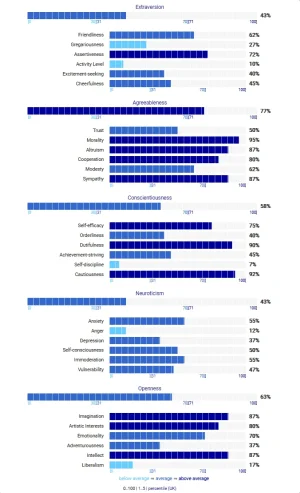
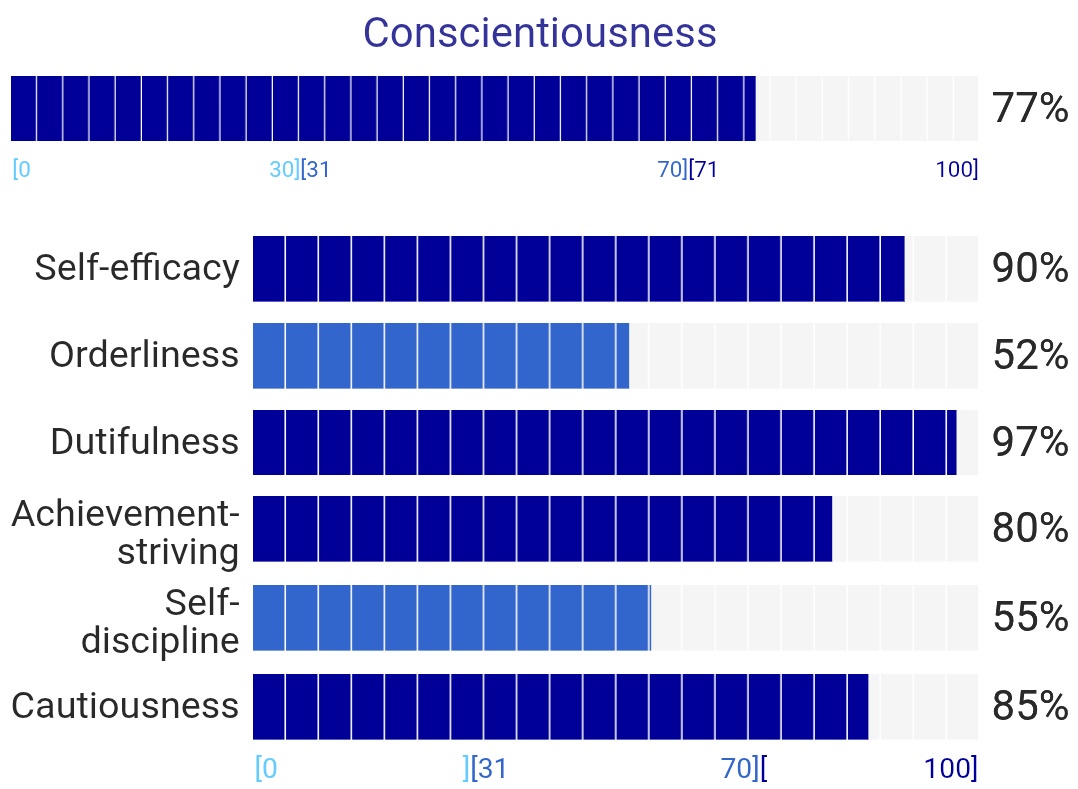
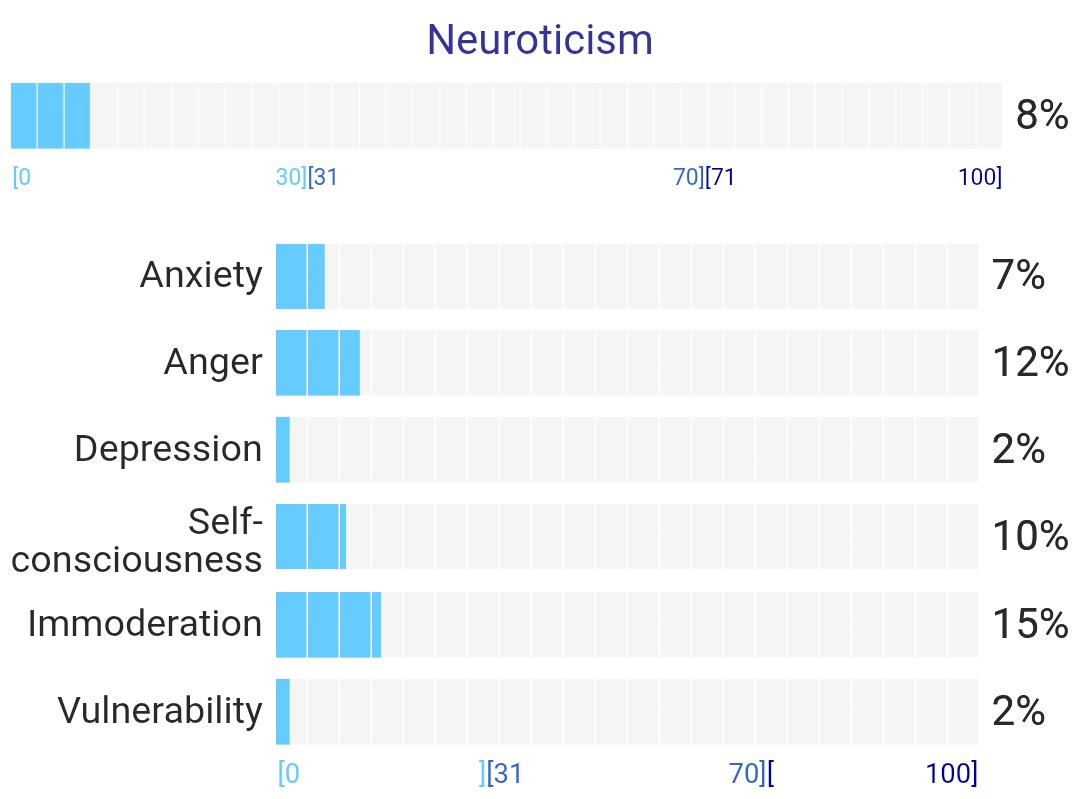
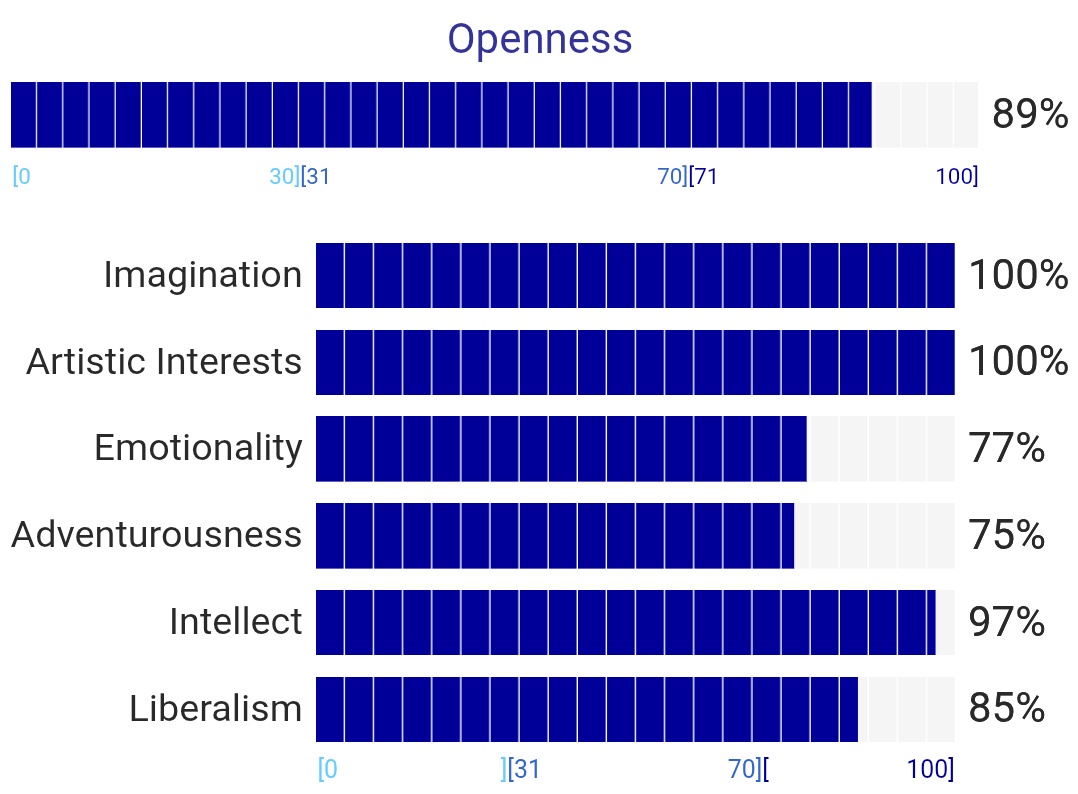
My results (from 300 Q test):

Big 5 300 Question Test.webp
 
I'll trade you self-discipline for Assertiveness...

My Assertiveness is probably a little higher.
Some of them are definitely inaccurate in a true sense.
The results are just self-perception.
And in knowing that, it's a good tool in further understanding how different mechanisms influence one another.
 
My Assertiveness is probably a little higher.
Some of them are definitely inaccurate in a true sense.
The results are just self-perception.
And in knowing that, it's a good tool in further understanding how different mechanisms influence one another.

I feel really good about my results in terms of their accuracy. I didn't find myself needing to or wanting to fabricate anything, and I was in a good state of mind while taking it.
 
He's written several books, which, by themselves, means nothing, but he has changed a lot of people's lives for the better. IRT diet, he's got this asinine idea that people should only be eating beef, which is just nuts to me.
I know he's written a book or two, and I think I even read one of them, and I know one of the young kids at the gym was reading it, but I told the kid, whatever the book was, something about 12 rules of life or something, there are a LOT more than 12 rules to life. So Peterson was a bit short on that. As for changing peoples' lives for the better, I've seen no statistical or scientific data on that, so I might challenge that suggestion for lack of evidence.

I have beef once a week, but most of my diet is fat. I suspect, once again, that the scientific evidence for eating only beef appears to be missing. And also I enjoy nuts.
Lots of people go to college to get away from their parents and party and such. If their parents pay for their schooling, they might even party harder.
I have trouble with this too. Perhaps there are statistical data somewhere that may support this apparent opinion.

My personal experience with other students is that, students who do this don't usually last past the first semester in college.

One engineer friend of mine did that (I was an engineer after my first college degree), partied his first semester in college and was kicked out of college. His grandmother had told him that if he decided to go to college, she would pay his way for him. But after he screwed-up his first semester in college, goofing off, partying, not studying, his grandmother cut him off and told him she would no longer pay his way.

After that, he told me about four long years of working to pay his own way through college. He became a piano tuner, working full-time, while taking a full-time load of engineering, physics, math, chemistry and general college classes. None of this was easy for him.

I had friends who partied, and so did I, but only on weekends, and only after mid-terms or finals were complete. Anyone who partied out-of-sync was ousted and never finished college. Students party hard - but they also work hard.

If you got to graduate school, one of the key survival techniques was the ability to find FREE FOOD. Graduate students became especially good at this. There was always some symposium or lecture being given and in every case, there was free food. I got pretty good at this, myself. You might just be walking past one of these events, see people in the lecture hall, standing around, waiting for someone to show up, walk right in, have a seat, or get in the line for the free food. No one would stop you because they naturally assumed you were there for the lecture.
 
I know he's written a book or two, and I think I even read one of them, and I know one of the young kids at the gym was reading it, but I told the kid, whatever the book was, something about 12 rules of life or something, there are a LOT more than 12 rules to life. So Peterson was a bit short on that. As for changing peoples' lives for the better, I've seen no statistical or scientific data on that, so I might challenge that suggestion for lack of evidence.

I have beef once a week, but most of my diet is fat. I suspect, once again, that the scientific evidence for eating only beef appears to be missing. And also I enjoy nuts.

I have trouble with this too. Perhaps there are statistical data somewhere that may support this apparent opinion.

My personal experience with other students is that, students who do this don't usually last past the first semester in college.

One engineer friend of mine did that (I was an engineer after my first college degree), partied his first semester in college and was kicked out of college. His grandmother had told him that if he decided to go to college, she would pay his way for him. But after he screwed-up his first semester in college, goofing off, partying, not studying, his grandmother cut him off and told him she would no longer pay his way.

After that, he told me about four long years of working to pay his own way through college. He became a piano tuner, working full-time, while taking a full-time load of engineering, physics, math, chemistry and general college classes. None of this was easy for him.

I had friends who partied, and so did I, but only on weekends, and only after mid-terms or finals were complete. Anyone who partied out-of-sync was ousted and never finished college. Students party hard - but they also work hard.

If you got to graduate school, one of the key survival techniques was the ability to find FREE FOOD. Graduate students became especially good at this. There was always some symposium or lecture being given and in every case, there was free food. I got pretty good at this, myself. You might just be walking past one of these events, see people in the lecture hall, standing around, waiting for someone to show up, walk right in, have a seat, or get in the line for the free food. No one would stop you because they naturally assumed you were there for the lecture.

You are being inconsistent. What to know how? Or can you guess already?
 
Peterson was a college professor and he worked several jobs. Even on digging dirt for a railway station.

I don't think it's easy to say he doesn't know what hard work is.

He was very intelligent on tests he took so knows how to speak but he felt the laws in canada were going to suppress him and others.

People think he is anti LGBT but his reasons for him speaking up had nothing to do that because he is not.

He does not go around insulting people based on orientation or anything, people say he does but he said he must personally know who you are and not be forced into some kind of coercion.

He had a bad experience on twitter where people ganged up on him.
 
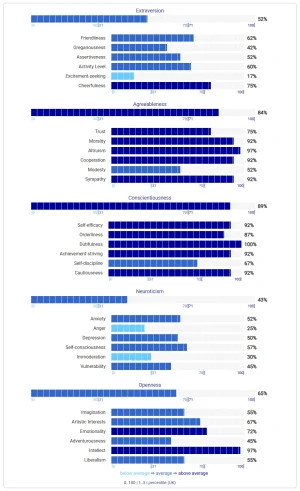
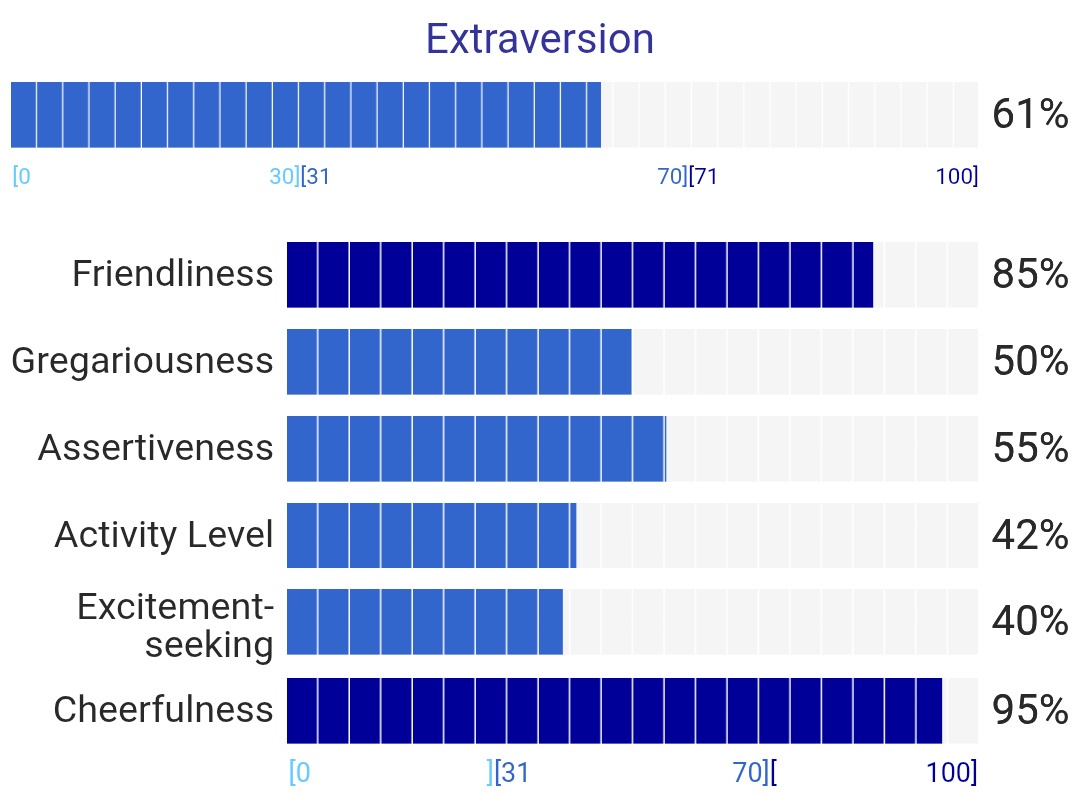
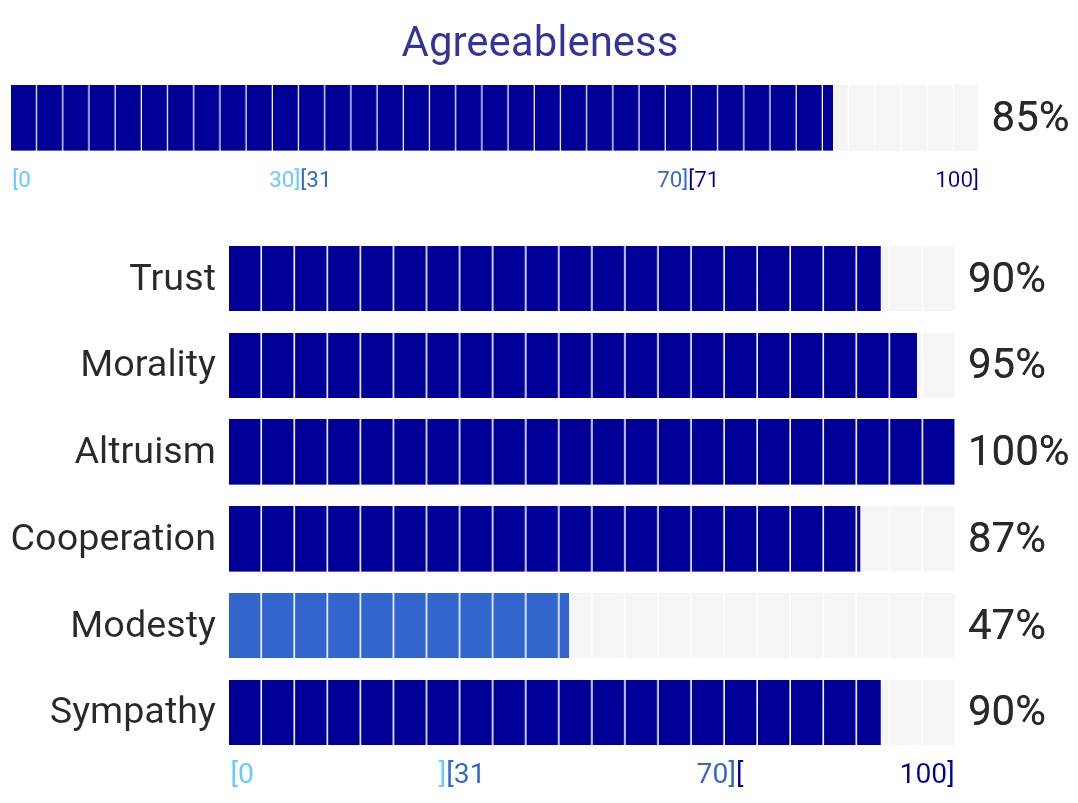
Took the 300...

595VRVt.jpeg

wL02j8i.jpeg

j2VRUPv.jpeg

kP1C6Nt.jpeg

stROTQH.jpeg


Cheers,
Ian
 
I feel really good about my results in terms of their accuracy. I didn't find myself needing to or wanting to fabricate anything, and I was in a good state of mind while taking it.

I feel the need to clarify, because your response seems to imply that I somehow felt differently.
My results are accurate in how I perceive myself. I felt no need or desire to fabricate anything.
Some of the questions were a bit open ended in my mind so maybe a slightly difference experience for me.
The point I was making is that there is some level of error in how we all perceive ourselves vs how others perceive us.
What I think I am and what another individual thinks I am has some variance to it.
 
The point I was making is that there is some level of error in how we all perceive ourselves vs how others perceive us.
Very true statement and applies to the INFJ chameleon significantly more than more than other types. This was not pointed at you but instead stated in the abstract.
 
I feel the need to clarify, because your response seems to imply that I somehow felt differently.
My results are accurate in how I perceive myself. I felt no need or desire to fabricate anything.
Some of the questions were a bit open ended in my mind so maybe a slightly difference experience for me.
The point I was making is that there is some level of error in how we all perceive ourselves vs how others perceive us.
What I think I am and what another individual thinks I am has some variance to it.

I was just talking about myself.
 
Back
Top