Tolkien

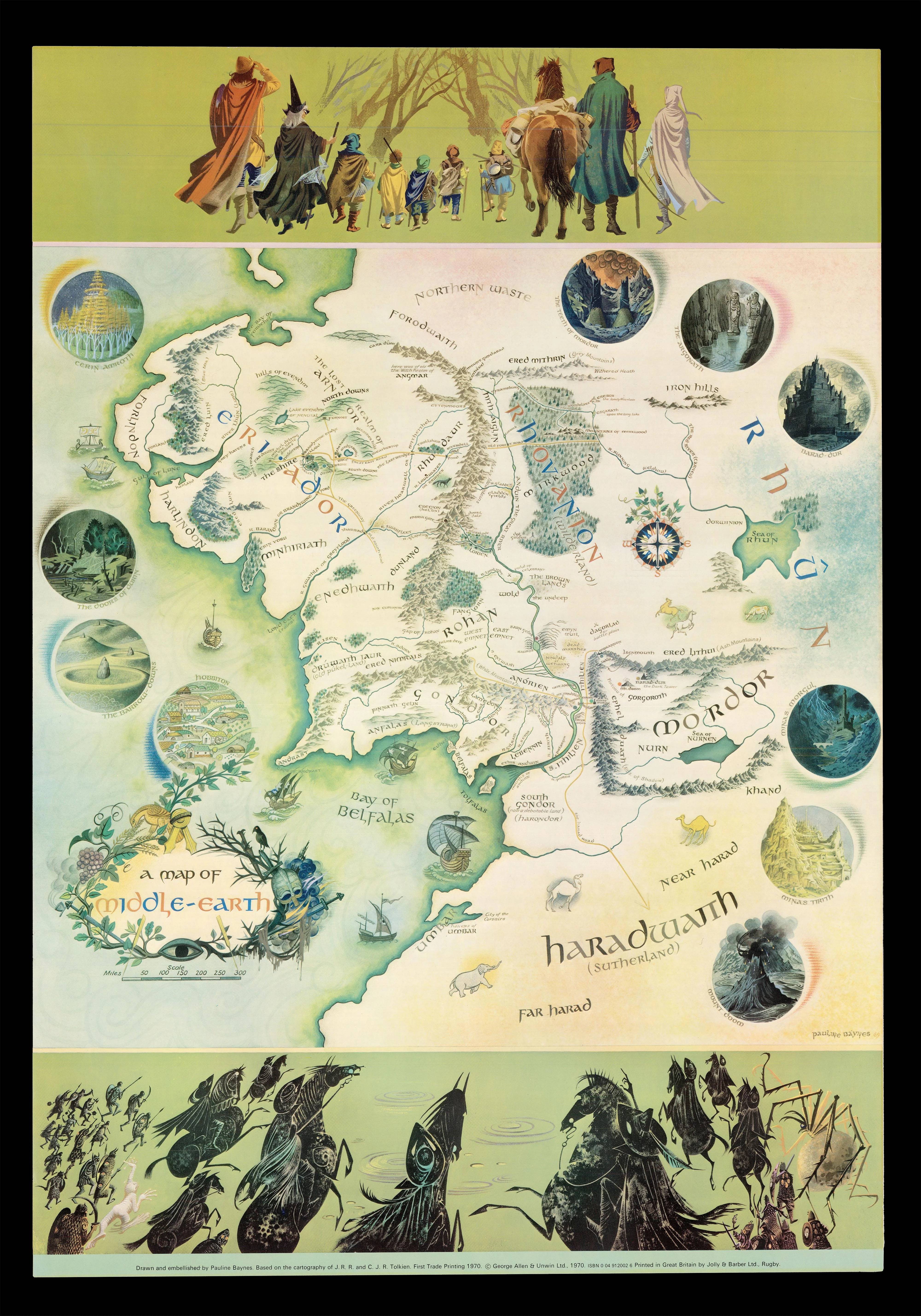
Map of Middle Earth by Pauline Baynes

OCKT90I.jpeg


From Nature of Middle Earth, Part II, Chapter VI,Descriptions of Characters, page 191 :
In 1970 Allen & Unwin published a poster-sized Map of Middle-earth, executed by the artist Pauline Baynes, and based upon that included in The Lord of the Rings. On the map itself are a series of vignettes portraying various locations significant to the story, such as the Barrow-Downs and Minas Tirith; and above and below the map proper, Baynes depicted the members of the Fellowship of the Ring, the Black Riders, Gollum, Shelob, and other enemies of the West. On seeing the finished art, Tolkien wrote a set of comments on these depictions of places and characters. Some of these comments are appreciative: e.g. Tolkien found four of the vignettes, sc. those depicting the Teeth of Mordor, the Argonath, Barad-dûr, and Minas Morgul, particularly well-executed, and described them as agreeing “remarkably with my own vision … Minas Morgul is almost exact”; and he found the depiction of Aragorn good, those of Sam and Gimli “good enough”, and that of Boromir to be “the best figure, and most closely related to the text”. Other comments are less positive: e.g. of the vignettes he singled out those of Minas Tirith and Hobbiton for particular dislike; and of the depictions of characters he most disliked those of Gandalf, Legolas, Gollum, the Black Riders (though he found them “impressive as sinister cavaliers”, he decried the addition of “hats and plumes” and the “relief” of “their hell-black with elvish green”), and Shelob (faulting in particular the positioning of her legs as “all apparently growing out of her head”) – also that of Bill the Pony: “On the scale of the men and the hobbits Bill is no pony. Also he was represented as having become the special care and friend of Sam, who should be leading him”. In the course of these comments he offers details of how some of these characters appeared in his own vision (some of which have been presented elsewhere),as well as on the personality and roles of some, and these details are selected and arranged for presentation here.

Then from Tolkien Maker of Middle Earth, page 384:
Westfield College, London Watercolour, 1952–2013 Collection: The Bodleian Libraries, University of Oxford MS. Tolkien Drawings 500
Pauline Baynes was the only artist approved by Tolkien to illustrate his works during his lifetime. Their association began in 1949 when she was asked by his publisher to submit illustrations for his faux-medieval tale, Farmer Giles of Ham. Tolkien was delighted with them, declaring they are “more than illustrations, they are a collateral theme.” Shortly afterwards he recommended her to his friend C. S. Lewis, who needed an illustrator for The Lion, the Witch and the Wardrobe. She went on to illustrate all the Narnia stories. She created this pictorial poster map of Middle-earth after extensive consultation with Tolkien. She added vignettes of many of the key places, as well as a header and footer showing the Fellowship and their pursuers. Of the vignettes Tolkien wrote, “some of these pictures agree remarkably with my own vision: especially the first four on the right (Minas Morgul is almost exact).”
20 December 1949
Dear Miss Baynes, May I just wish you a Happy Christmas. I meant to write you an answer to your letter of last June, but I became involved in examinations, the end of an academic existence, in this case involving two extended courses in Oxford. I am sorry that F.C., the author of which in Oxford seem (?) will have gone off, but you might at least as much by the help(?) as any others(?) else. I hear from my friend C. S. Lewis, who saw the original and was much impressed by your work, that he has got in touch with you. I have two (large) books to illustrate, one of a very practical kind that seemed in 1950 to be actually becoming production problems; and I shall very much hope that some illustrations or decorations will be part of the programme. In the case I hope you shall meet in what was the most likely point, London. Though I hope local good fortune brings you here, you must let me know. Very sincerely, J. R. R. Tolkien 21 Dec. Thank you so much for your charming(?) cards(?) and your (?) ... [bottom note is too faint/obscured to reliably transcribe]
The caption below the letter reads: Fig. 120 Letter from Tolkien to Baynes, expressing the hope that she will illustrate his unpublished works ‘The Silmarillion’ and ‘The Lord of the Rings’, 20 December 1949. (Image provided courtesy of The Marion E. Wade Center, Wheaton College, Wheaton, IL)
 
Back
Top